
The Rainfall-Inflation Math: How Deficient Monsoons Impact the Economy
Cracking the Economic Formula: How Below-Average Rainfall Directly Drives Inflation
Jun 4, 2026, 11:00 IST
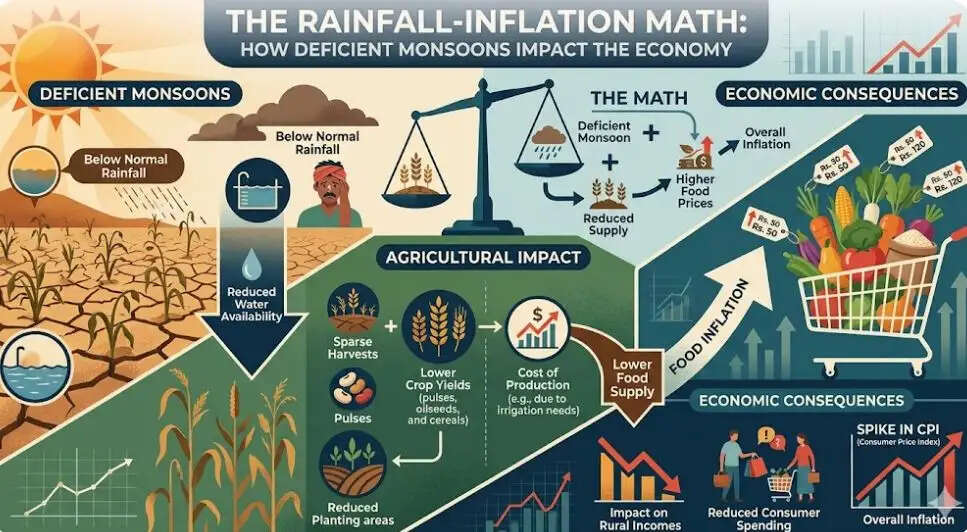
Delhi News Info Desk:- The intimate connection between seasonal weather patterns and macroeconomic stability remains an essential focal point for emerging markets.
Whenever country-wide rainfall levels drop below seasonal averages, it triggers an immediate negative reaction across agricultural supply lines.
This rainfall deficit calculation maps out how low precipitation shrinks crop yields, directly translating into a sharp surge in the Consumer Price Index (CPI) and disrupting central bank monetary planning.
[Low Rainfall Inflation Supply Chain Reaction]
Deficient Monsoons -> Poor Sowing Area -> Lower Farm Yields -> Supply Scarcity -> High Food Inflation
The Domino Effect on Agricultural GDP and Monetary Policy
When key crop cultivation zones receive lower-than-expected rainfall, harvest outputs for essential commodities contract significantly.
This initial supply shock triggers a rapid increase in food pricing metrics, which carry a heavy weighting within the headline inflation basket.
To counter this supply-side price pressure, the Reserve Bank of India (RBI) is often forced to keep interest rates elevated for longer periods to prevent inflation from spilling over into the broader services economy.
Ultimately, poor monsoons hit rural disposable incomes, slow down consumer spending, and create complex headwinds for overall GDP expansion.